






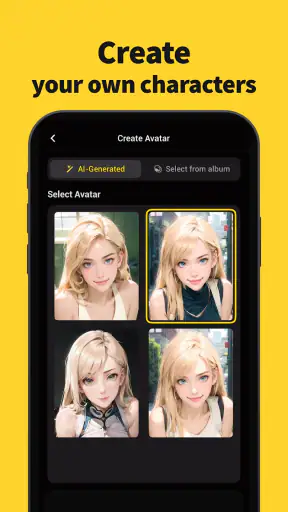
I approached Fantasia: Character AI Chat as an entertainment app built around one clear idea: talking with AI characters through role-play. That focus makes it feel different from a normal chatbot, where I usually have to explain the tone, setting, and personality I want before the conversation becomes interesting. Here, the appeal is the character-led exchange itself. I can enter a fictional situation, respond in my own words, and see how the conversation develops.
That sounds simple, but it changes how I use an AI companion. Instead of treating every message as a question-and-answer task, I use the chat as a small interactive scene. It can be playful, dramatic, romantic, strange, or purely imaginative, depending on the character and the direction I give the conversation. My overall impression is that Fantasia works best when I treat it as a flexible storytelling space rather than as a replacement for a search engine, a personal assistant, or a real relationship.
Role-play is the feature that shapes the whole experience
The app’s central capability is AI companionship through character conversations. That means the quality of the experience depends less on finding a single “correct” answer and more on whether the exchange feels consistent enough to keep me engaged. A useful reply in this setting is not always the most factual one. It may be a reaction that keeps a scene moving, reveals a personality, or gives me something interesting to answer.
I found this distinction important during my first conversations. If I approached a character with short, vague prompts, the exchange could feel flat. When I gave the scene a little direction—what was happening, what mood I wanted, or how my character should react—the conversation became easier to guide. The best results come from treating each message as a writing prompt, not merely a request for information.
That makes Fantasia especially appealing to people who enjoy improvisation but do not always have a writing partner available. I can test a scene, explore dialogue, or simply pass time with a fictional personality that responds immediately. The app belongs in the entertainment category, and that is the right way to judge it: its value is measured by engagement, imagination, and conversational momentum rather than practical productivity.
MINDZEN AI presents the app as Fantasia, with the short store description “Fantasia,” while the fuller name makes its purpose clearer. It is free to install, although optional purchases range from $1.99 to $199.99 per item. That wide range is worth noticing before I become deeply invested in the experience. The free starting point makes experimenting easy, but anyone who dislikes in-app purchase systems should decide early how much they are comfortable spending.
What changes when the conversation is character-led
A conventional chatbot usually begins with a blank page. I supply the task, define the context, and correct the tone when it goes wrong. A character AI chat starts from a different expectation: I am entering someone else’s fictional frame. Even when the underlying interaction is still text-based, the role-play angle gives each reply a reason to exist beyond information delivery.
In practical terms, this can make a quiet evening feel more interactive. I might begin with a casual greeting, introduce a problem, and then choose whether to be cooperative, sarcastic, cautious, or dramatic. The conversation becomes a sequence of choices made through language. There is no need to prepare a full story first, which is one of the app’s strongest advantages for spontaneous use.
At the same time, character chat asks more from me than passive entertainment. A television show carries the plot without my help. A game often gives me rules, objectives, and visible progress. Fantasia leaves more of the direction in my hands. That freedom is exciting when I want to improvise, but it can also feel aimless when I expect a structured adventure with clear goals.
How I get more from a session
I learned to open a conversation with a specific intention instead of waiting for the character to create everything. A simple setup works well: where the scene takes place, what has just happened, and what kind of response I want. For example, I might establish that two characters are meeting after an argument and ask for a tense but restrained exchange. That gives the role-play a usable starting point without turning the message into a long script.
Another helpful habit is to correct the direction immediately. If a character becomes too cheerful, too formal, or too passive, I say so plainly within the conversation. I do not assume the app will automatically preserve every subtle preference forever. Short reminders are more effective than silently hoping the next reply will repair the tone.
I also get better results by leaving room for the character to answer. If I write every action, emotion, and line for both sides, there is little space for the AI to contribute. A more balanced message describes my character’s action and then ends at a point where the other character has something meaningful to do. This turns the interaction into a back-and-forth rather than a request for the app to rewrite my own paragraph.
A less obvious use is rehearsal. I can try different versions of a fictional conversation without the pressure of showing anyone the result. That does not make the AI a reliable judge of real human behavior, but it can help me explore how a scene sounds. I use it for dialogue practice, character brainstorming, and testing whether a story conflict feels believable before writing it elsewhere.
How it feels in everyday use
My most natural scenario for Fantasia is a short evening session when I want something interactive but do not want to commit to a full game, book, or series. I choose a character, establish a situation, and spend a few minutes responding to the unfolding exchange. If the conversation finds a good rhythm, I continue. If it does not, I can change direction without losing much time.
This flexibility is more useful than it first appears. A traditional entertainment app often asks me to select from finished content. Fantasia asks me to participate. On a commute, during a break, or while waiting for an appointment, that can be enough to make the experience feel personal. I can stop after a handful of messages and return later when I have more energy for the scene.
However, I would not describe every session as equally absorbing. Role-play depends heavily on the opening prompt and on how willing I am to steer. When I am tired and want effortless entertainment, a video, podcast, or conventional game is often a better choice. Fantasia rewards attention. It is light on preparation, but it is not completely passive.
A practical workflow for writers and creative users
For creative work, I would use the app as a conversational sketchbook rather than as a final writing tool. I can ask a character to react to a dilemma, play out a disagreement, or expose a weak point in a scene. The useful result is not necessarily a polished passage. It is the unexpected response that shows me another possible direction.
One effective workflow is to run the same fictional problem through different personalities. I can keep the situation stable while changing the character’s attitude, then compare which reactions create the strongest tension. This helps me discover whether a scene depends on the plot itself or merely on one particular voice. It also prevents me from settling too quickly on the first idea that sounds acceptable.
Another is to use role-play to identify missing context. If I introduce a character who is supposed to be suspicious but never explain what they know, the conversation may expose that weakness. The AI is not a substitute for editorial judgment, yet its questions and reactions can reveal where my own setup is too vague.
For this kind of use, I recommend keeping important writing in a separate app. Chat is a good place to explore, but I would not rely on an entertainment conversation as my only archive for a developing project. Copying useful ideas into notes also makes it easier to edit them without the role-play framing.
The difference between companionship and conversation
The word “companion” can set expectations that an AI chat cannot fully meet. Fantasia can respond, adopt a role, and provide a sense of ongoing interaction, but it does not have human feelings or personal responsibility. I find the experience healthier when I remember that the emotional effect comes from the design of the conversation and from my own imagination.
That does not make the entertainment value unreal. Fictional characters have always helped people relax, reflect, and explore emotions. The difference is that an AI character answers directly instead of following a fixed script. I can influence the tone and direction, which makes the exchange feel more immediate than reading a static story.
Still, I would be careful about using it as the only outlet for loneliness or serious emotional distress. A real friend, counselor, or trusted support service is better suited to situations that require human understanding, accountability, or professional care. Fantasia can be a private imaginative activity, but I would not confuse responsiveness with genuine personal support.
Where the experience becomes less comfortable
The first trade-off is unpredictability. A character may respond in a way that does not fit the mood I established, forcing me to redirect the scene. In a normal game, a mismatch can often be explained by a rule or a scripted branch. In AI role-play, the cause is less visible. I may understand what I wanted, while the character takes the conversation somewhere else.
That unpredictability can be entertaining when it creates a surprise, but frustrating when it breaks immersion. I have found that the best approach is to decide whether the mistake is worth correcting. Sometimes I rewrite the scene and continue. Other times, I accept the unexpected turn and see whether it produces a better story. The app is more enjoyable when I treat occasional inconsistency as part of improvisation rather than expecting perfect continuity.
The second trade-off is the purchase model. The app is free, which lowers the barrier to trying it, but the presence of optional items priced from $1.99 up to $199.99 means I would pay attention to any purchase prompt. I would especially avoid spending impulsively during an emotionally engaging conversation. Setting a personal limit before starting is a small but sensible safeguard.
The mature age rating also matters. Fantasia is intended for users aged 17 and over, so it is not an app I would hand to a younger teenager simply because the interface looks like a standard chat. Adults should still use judgment about the themes they introduce and the kind of interaction they want. The role-play format can move into intense or sensitive territory depending on how it is used.
Privacy is another reason to think before typing. I would keep identifying information, private passwords, financial details, and sensitive personal records out of an entertainment chat. Even when I am using a fictional character, I can describe a situation in general terms instead of turning the conversation into a diary containing details I would not want exposed.
There is also a time-management trade-off. Because the conversation is open-ended, it is easy to continue simply because the next reply is available. I prefer using a natural stopping point, such as completing a scene or reaching a decision, rather than scrolling indefinitely. This makes the app feel like a chosen activity instead of an endless feed.
When another entertainment option is better
If I want a carefully authored story with dependable pacing, a novel, television series, or narrative game is a stronger choice. Those formats give me a finished creative vision and usually maintain continuity better than an improvised AI exchange. If I want a competitive challenge, clear objectives, or measurable progress, a conventional game will also serve me better.
If I need accurate facts, current information, or professional guidance, I would choose a purpose-built tool instead. Fantasia’s strength is not verification. Its role-play focus makes it suitable for imagination and amusement, not for decisions where an incorrect answer could cause harm.
I would also skip it if I strongly dislike typing. The app’s appeal depends on participating in the exchange, and short replies can work, but the richest sessions usually require some effort. People who prefer passive listening or visual entertainment may find the experience too demanding for casual downtime.
Who is most likely to enjoy Fantasia
I think the best audience includes people who like interactive fiction, character writing, improvisation, and low-pressure creative experiments. It is particularly useful for someone who has story ideas but wants to hear characters respond before committing to a draft. It can also suit users who enjoy trying different conversational moods without needing a group of friends online at the same time.
The app has already attracted a substantial audience, with over a million installs, and its average rating is 4.2 from around fifty-one thousand ratings. Those figures suggest that the basic concept connects with many users, although they should not replace my own judgment about whether open-ended role-play matches my habits.
Fantasia comes from MINDZEN AI and was released on February 29, 2024. The current version is 2.6.0, and it supports Android 7.0 or later. That makes checking the device requirement worthwhile before installing, especially on an older phone. The app is free to start, but I would approach the purchase options with the same care I would use for any entertainment service that can become more engaging over time.
For me, the strongest reason to recommend it is not that every conversation will be perfect. It is that the app gives me a quick way to enter a fictional exchange and influence what happens next. The experience becomes genuinely rewarding when I bring a clear premise, allow the character room to respond, and accept that improvisation includes occasional detours.
My final view is positive but specific: Fantasia is a good fit for interactive role-play, not a universal AI assistant. I would recommend it to adults who enjoy character-driven conversations and understand the limits of AI companionship. I would not recommend it to someone seeking dependable facts, structured gameplay, or a substitute for human support. Used with realistic expectations and sensible boundaries, it offers an engaging way to turn a few spare minutes into a small, personal story.


